Estimia: Honest Window Prices for All of Spain
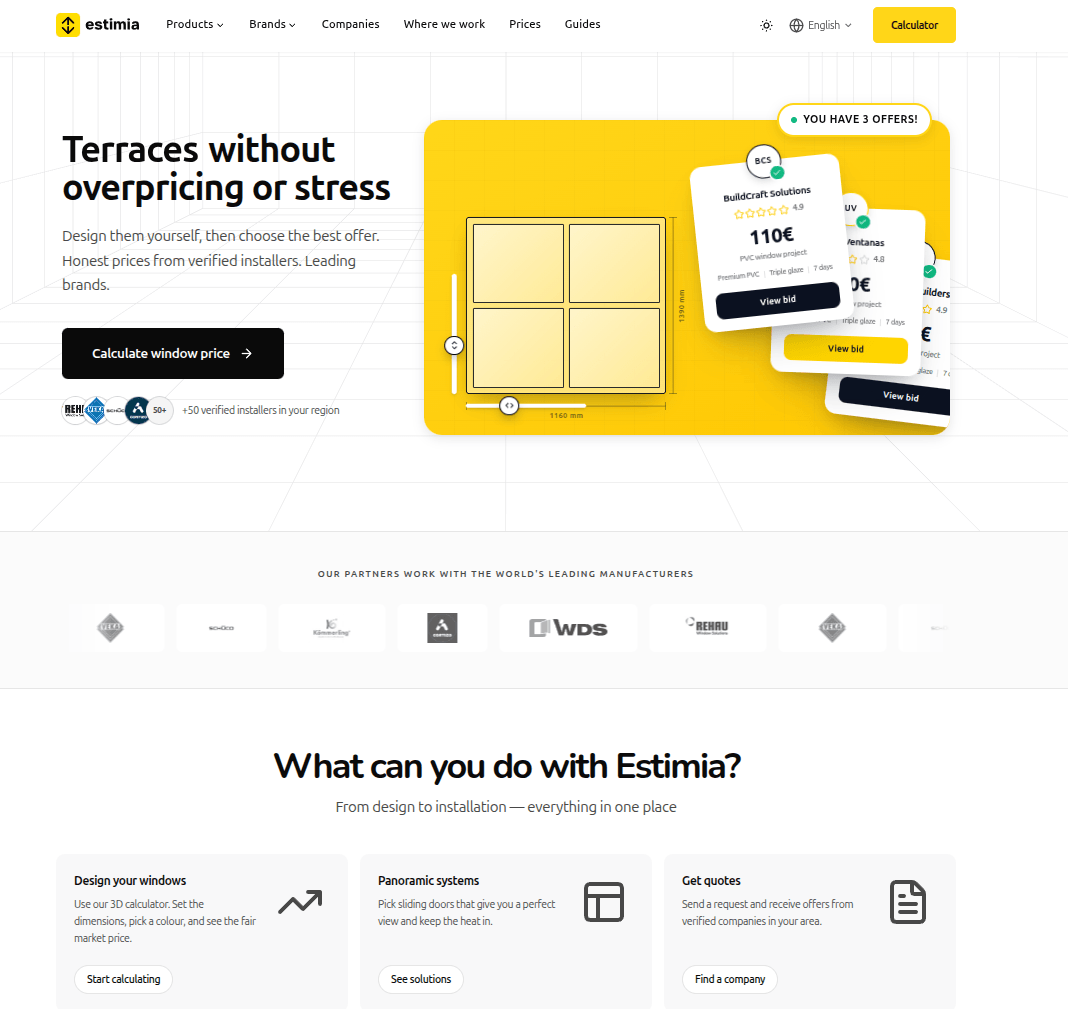
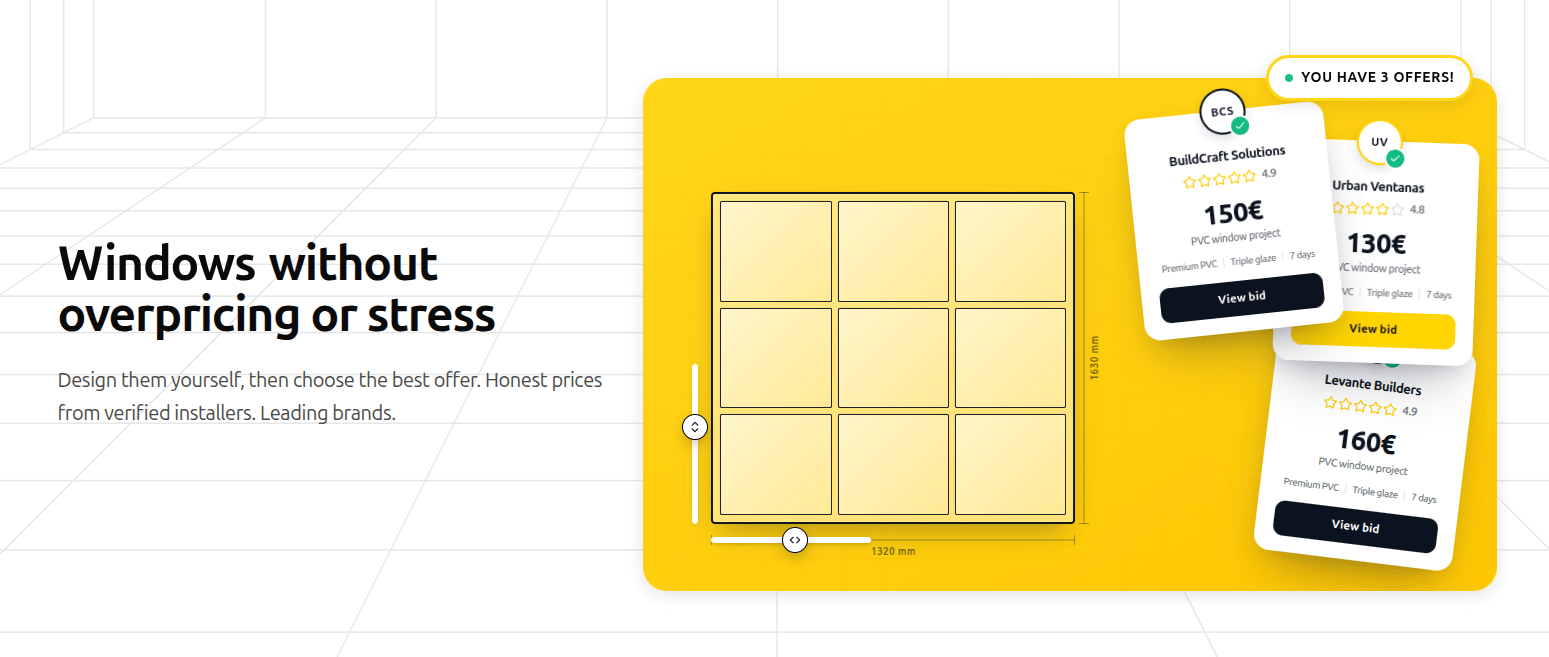
Buying windows in Spain means chasing opaque quotes from installers who each measure differently. Estimia fixes that with a real online calculator, honest national pricing, and 156 regional pages grounded in real climate data and the Spanish building code — all on a static site that loads instantly.
The Challenge
Build a price comparison platform for windows and doors that covers all of Spain, in three languages. The hard part isn’t the technology — it’s earning trust. The window market is full of thin, templated “best windows in {city}” pages with invented prices. Estimia had to do the opposite: be a large-scale site that is genuinely useful on every single page.
The Problem with Buying Windows
If you need windows in Spain today, the process is opaque. You call a few installers, each comes to measure, each quotes differently, and there’s no way to know whether €4,000 for your living room is fair or double the market rate. Prices aren’t published anywhere. Most online guides are either gated lead forms that hold the information hostage for a phone number, or content farms padding pages with numbers nobody verified.
The buyer has no reference point, and no honest way to compare one installer against another on the same job.
The Solution: An Honest Comparison Engine
Estimia is built around a simple promise: real prices, a real calculator, and quotes from several verified installers on the same specification — free and with no obligation.
Every number on the site traces back to a real source. Prices come from a single national index calibrated against actual 2026 manufacturer quotes — never a fabricated “prices in Alicante are €X.” Climate figures come from ERA5 reanalysis data. Building-code limits come from the actual Spanish CTE tables. Company ratings come from the directory, not from us.
This honesty isn’t a slogan — it’s the principle the whole project is built on. When every figure can be traced to a real, cited source, the buyer can act on it with confidence instead of wondering what’s being hidden behind a lead form.
The Calculator: Build Your Actual Window
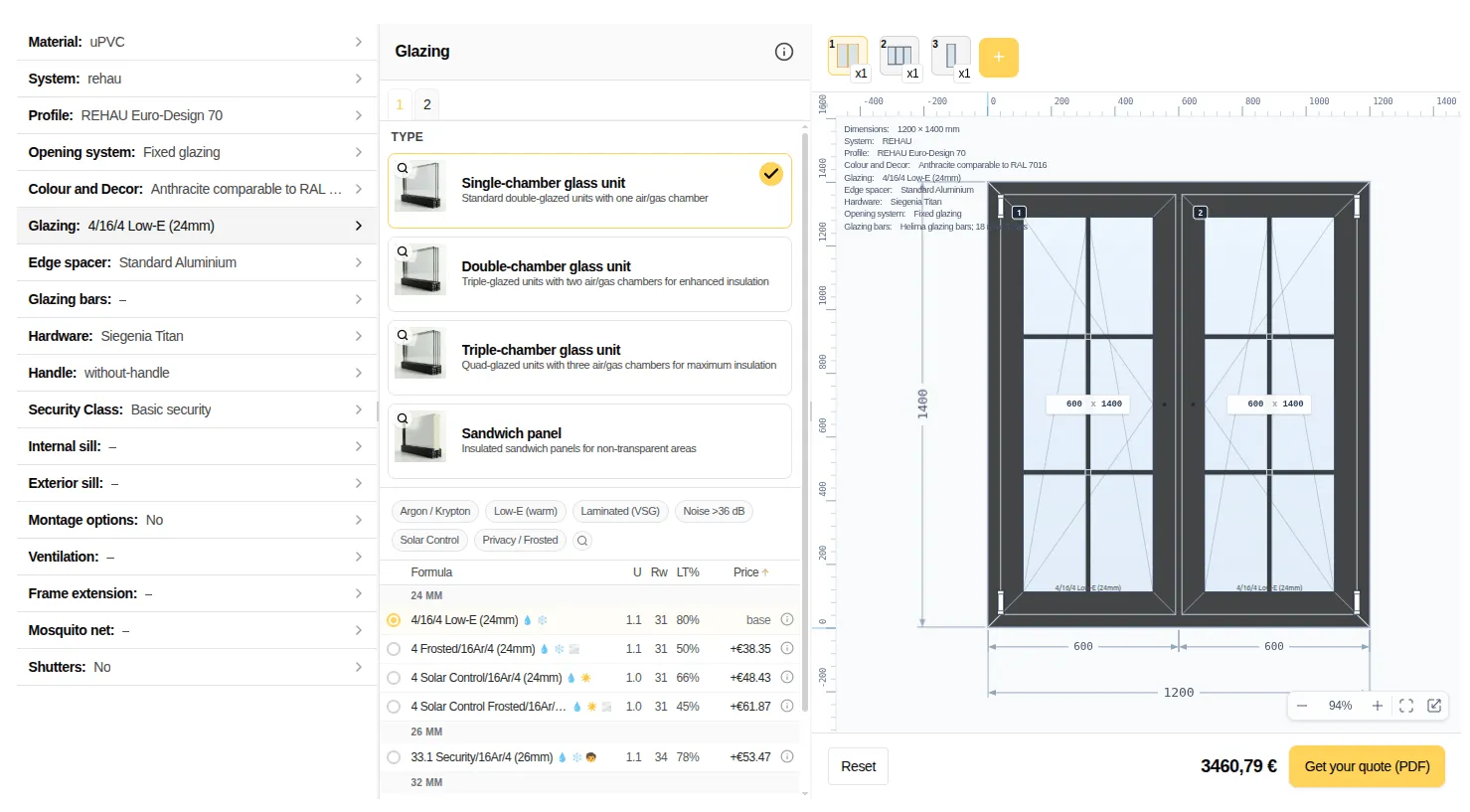
At the heart of Estimia is a professional-grade window configurator — the kind of tool a factory’s sales engineer normally keeps to themselves, handed directly to the buyer. You don’t pick from a vague menu of “small / medium / large.” You build your actual window, parameter by parameter: material and profile system, opening type, colour and decor, the exact glazing formula, edge spacer, hardware brand, security class, interior and exterior sills, ventilation, mosquito nets, shutters. Add as many sashes as your opening needs, and a precise technical drawing redraws itself alongside — real dimensions, glazing labels, the lot.
That drawing isn’t a stock image being swapped in and out. Behind the scenes a custom geometry kernel built on Paper.js renders it live on a 2D canvas, so every sash, transom and profile depth is mathematically accurate to the window you’re configuring. It goes deep where it counts, too: choose a glazing unit and you see its genuine specs — thermal transmittance, acoustic rating in decibels, light transmission — and exactly what each upgrade adds to the price. The total updates with every change, and when you’re done you export the whole specification as a PDF quote you can take anywhere.
What makes the number trustworthy is the catalog behind it. Each installer company can load its own pricing — its own profiles, glazing options and margins — or build on ready-made price lists from established Spanish factories. So the figure you see isn’t a guess pulled from the air; it’s grounded in a real, current manufacturer catalog, configured exactly to the window you just designed.
AI-Assisted Quotes
When a visitor is ready for a real quote, an AI assistant takes over. Instead of a long, intimidating form, a multi-turn interview powered by Anthropic Claude walks them through their project one question at a time — project type, number of openings, photos, rough dimensions, glazing, colours, acoustic and solar priorities.
The visitor can simply type, or attach photos and PDFs of factory specs and floor plans — Claude reads them natively. As the conversation progresses, the model turns free-form answers into a clean, structured order: a normalized brief that every installer quotes against.
That structured brief means the installer receives a clear, complete picture of the project from the very first contact — the right measurements, the priorities, the photos — instead of a one-line enquiry that needs three rounds of questions before anyone can respond. And a friendlier intake means more people see it through, turning a vague idea into a ready-to-quote order.
A Page for Every Province
Windows aren’t a one-size-fits-all purchase. What you should fit in Almería, baked by 3,000 hours of sun a year, is not what you should fit in Teruel, one of the coldest provinces in Spain. So Estimia has a dedicated page for windows in each of Spain’s 52 provinces — in all three languages — and each one is written around the place it covers, not stamped out from a template.
Every province page brings together three things a buyer there actually needs to know:
- Local climate. Real monthly temperature and rainfall figures for that province, shown as a clear chart, with a recommendation that follows from them — solar-control glazing where summers are punishing, triple glazing and a reinforced thermal break where winters bite.
- What the law requires. Spain’s building code (the CTE) sets minimum window performance by climate zone — the thermal transmittance and air-tightness a new installation has to meet. Each page spells out those limits for that province, so you know the spec your windows are legally expected to reach before anyone quotes you.
- Who can do the work. The page lists the verified installers that genuinely operate in that province. Where Estimia hasn’t onboarded any yet, it says so and invites local firms to join — rather than padding the page with companies that don’t really work there.
The result is that someone searching for windows in their own city lands on a page that speaks to their climate, their regulations, and the installers near them — useful on its own terms, before it ever asks them to request a quote.
Multilingual, Done Properly
The site runs in Spanish, English, and Russian — and not just translated body text, but translated URL slugs: /es/ventanas-madrid/, /en/windows-madrid/, /ru/windows-madrid/ are correctly cross-linked as language alternates.
The catch with translated slugs is that off-the-shelf sitemap tools can’t connect them — they don’t know ventanas and windows are the same page. So Estimia uses a custom generator that walks the real compiled output, groups the localized URLs back together, and writes the hreflang tags from that. Because it only ever references pages that actually exist in the build, there are zero broken language links, and the sitemap and the page always agree.
Static, Fast, Crawlable
Every page is generated in advance as a ready HTML file and served from Cloudflare’s global edge network. No database query on request, no server-side rendering of content, no JavaScript-gated text. Even the climate charts are computed at build time and shipped as static images, so there’s no chart-library payload to download.

The result is the maximum 100 out of 100 in Google’s speed tests — and fast, crawlable pages aren’t a later optimization here, they’re a structural property of how the site is built.
The Engine Room: A Marketplace for the Whole Trade
The polished comparison engine homeowners see is only half the product. Behind it is a full operating system for the window business — think “Uber for windows.” A homeowner’s request comes in, gets matched to the right local installer, and both sides track every stage from measurement to installation. The supply side runs entirely inside Estimia: each company gets a Kanban CRM that walks a job through its pipeline — new lead, measurement, quote, production, installation, completed — with the configurator and a one-click PDF quote builder (rendered through Gotenberg for pixel-perfect documents) built right into the order card, plus its own client database that remembers returning customers and pre-fills their details.
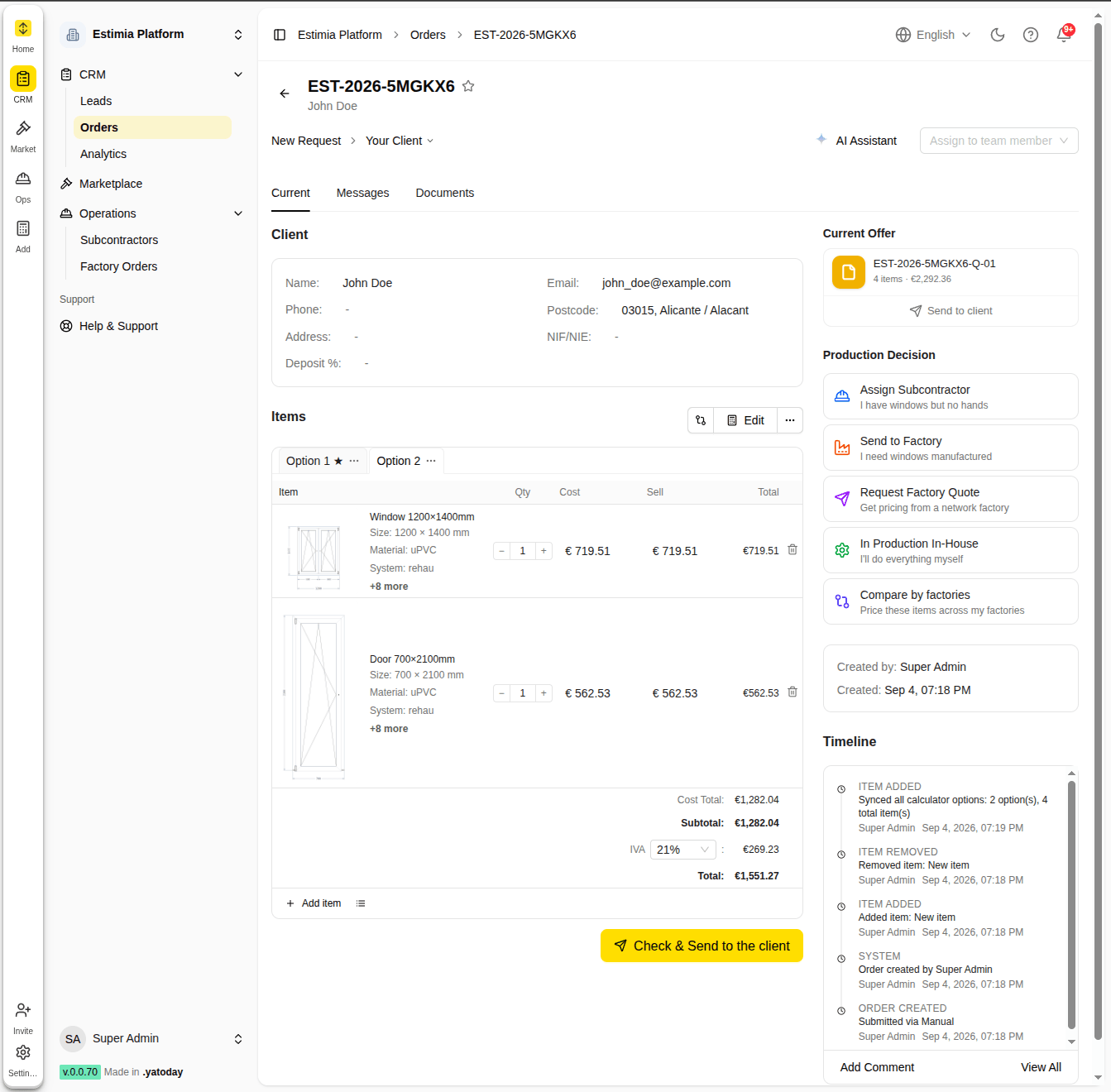
Everything about a job lives on one card. The client’s details, the line items with their live technical drawings and cost-versus-sell prices, the current offer ready to send, and the message thread with the client all sit next to a Production Decision panel that asks the only question that matters once the client says yes: who builds this? Assign a subcontractor, send the order to a factory, request quotes from network factories, keep it in-house — or compare all of them first. A timeline records every action, and an AI assistant sits at the top of the card, ready to help with the order.
What makes it a marketplace rather than just a CRM is how work flows between companies. A regional aggregator can route or hand a lead to a partner firm and then watch it progress live on that partner’s board — an observer view with SLA timers and a quality-audit callback that catches a deal quietly closed off the books. A dealer who has the client but not the hands can assign an external installer as a subcontractor; one who has the client but not a workshop can send the order straight to the Estimia factory to be manufactured at wholesale and shipped back. Every path is a different button on the same order, so a solo autónomo and a large network run on identical software.
And the homeowner is never left in the dark. A no-login client portal — a “pizza-tracker” for windows, reached by a single tokenized link — shows a live timeline of the order, lets the client message the company, approve the quote, and rate the work at the end. Subscriptions and the platform’s commission billing run on Stripe, with SEPA direct debit for the recurring B2B invoices that the Spanish market expects.
One Offer, Three Ways to Say Yes
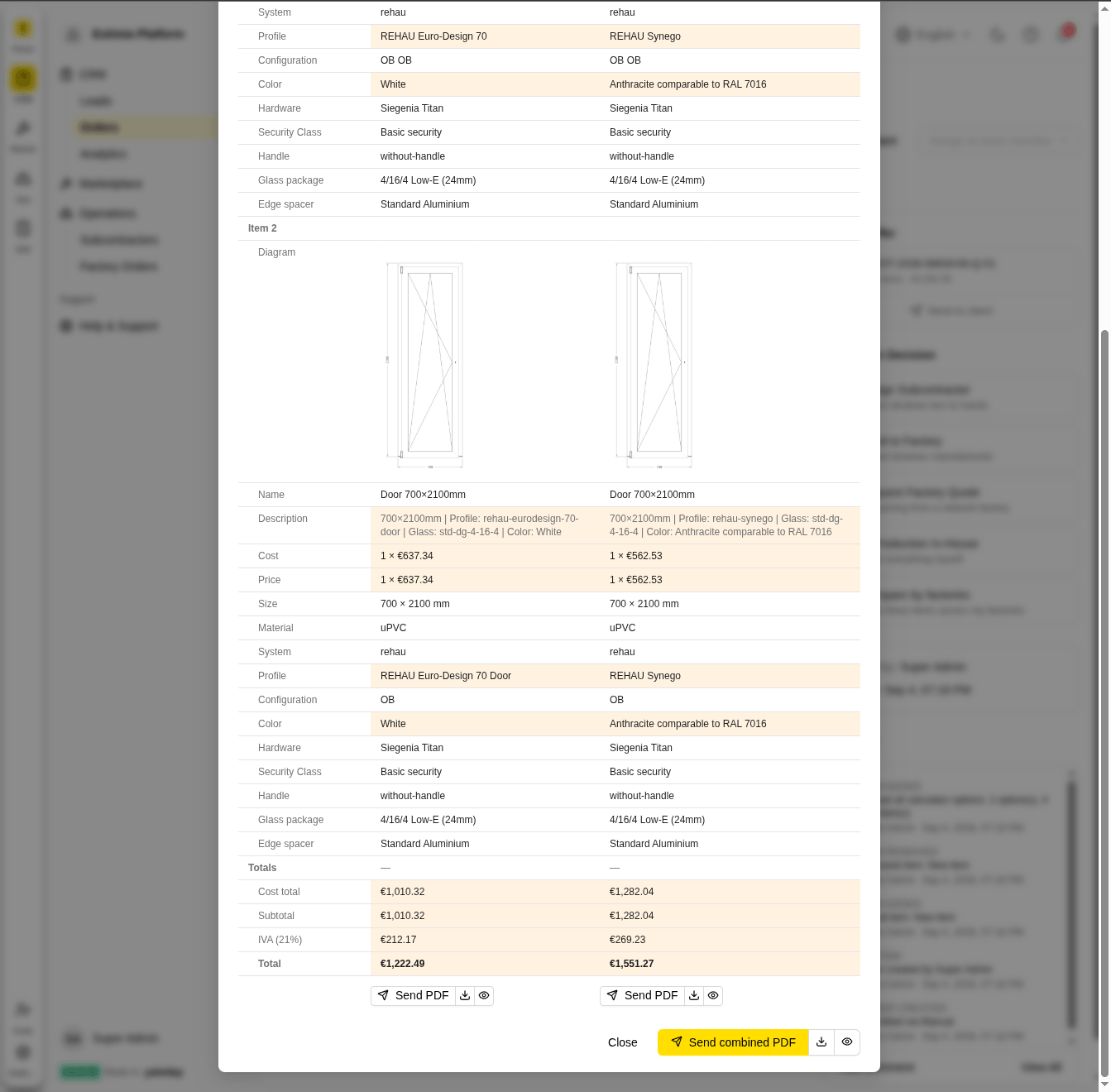
A single order in Estimia can carry several options — the same openings priced with different profile systems, glazing, colours or hardware — and the platform lays them out side by side, item by item, with every difference highlighted. The typical use is a three-tier offer: a budget option, a mid-range “optimal” one, and a premium one, all in a single document.
It’s a deliberate sales tactic. A client who receives one number compares it against a competitor’s number. A client who sees the whole picture — good, better and best from the same company — compares your options against each other, and the question quietly shifts from “who do we hire?” to “which one do we take?”. Each option gets its own PDF, or the entire comparison goes out as one combined PDF, and the client approves the option they want with a single click in the portal.
Compare by Factories: Order Each Item Where It Pays
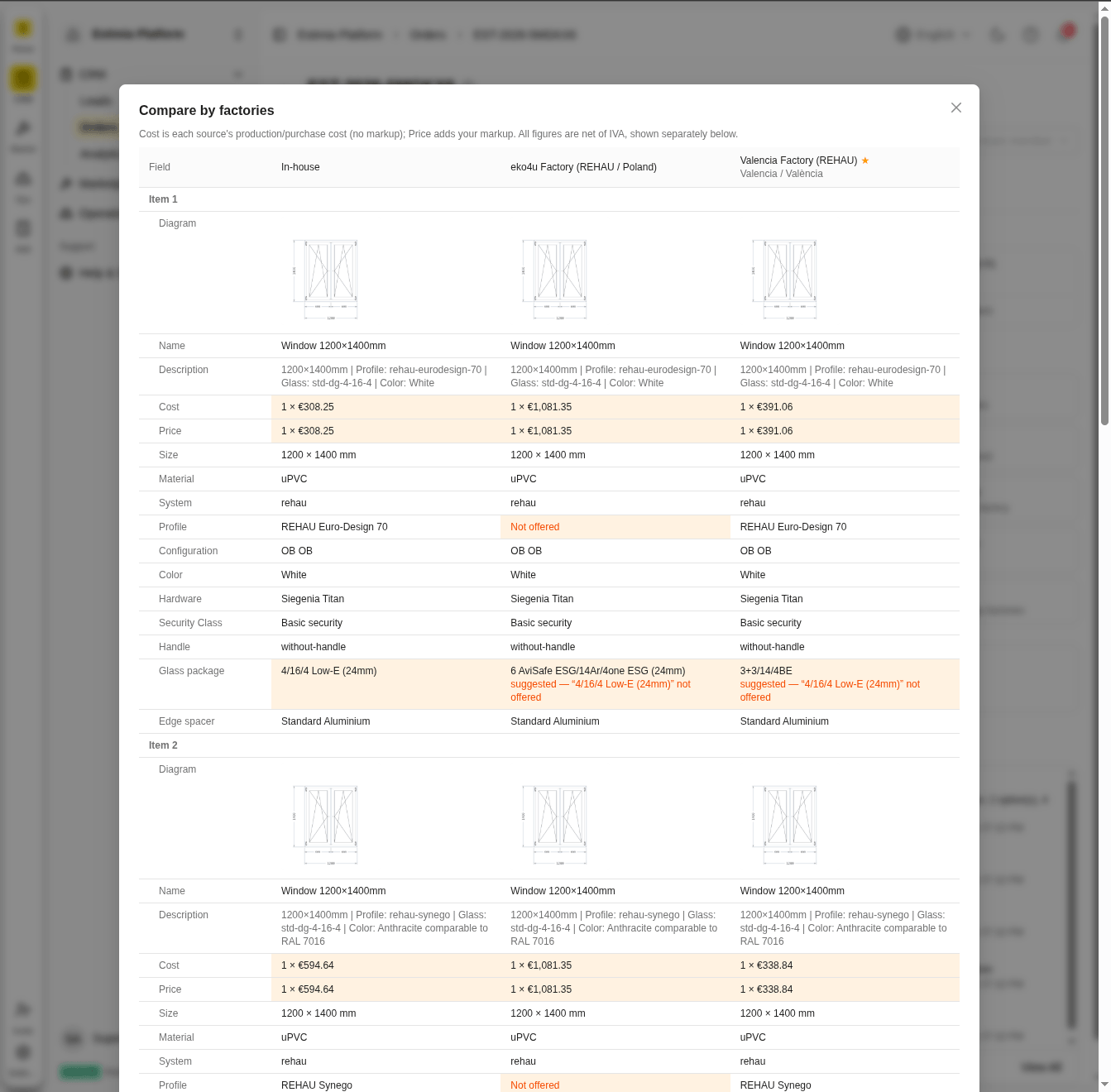
A dealer rarely makes everything in-house. Estimia lets a company attach the catalogs of the factories it works with — a REHAU plant in Valencia, a supplier in Poland — and re-price the whole order against each of them in one table. In-house cost sits in the first column; every attached factory follows. The same window can cost three times as much from one source as from another, while the second item in the same order is cheapest somewhere else entirely.
Because the comparison is per item rather than per order, the job can be split: order the first window from the factory where it’s cheapest and the second from a different one. Where a factory doesn’t carry the exact profile or glass unit, the table says Not offered and suggests the closest substitute rather than silently pricing something different. Factory workload is taken into account too, so the cheapest column isn’t automatically the right one if that plant is booked out. From the same panel, the chosen items go straight into a factory order or a request for quote.
Tools Other Sites Can Embed
Estimia builds tools for the window trade, and any related site — installers, renovation firms, real-estate portals — can put them on its own pages with a single copy-paste snippet. The widgets are hosted and kept current by Estimia: all JavaScript, CSS and data load from estimia.es, so they add no weight to the host site.
- Window Subsidy & IRPF Deduction Calculator. Free. The visitor sets a budget, province and property type and sees what new windows really cost after stacking the regional grant (Plan Estatal de Vivienda 2026–2030) and the income-tax deduction for energy-efficiency works (the 20%, 40% and 60% tiers). Three languages, light and dark themes, an auto-resizing iframe, a custom accent colour, and call-to-action buttons that lead to the host’s own quote form. The grant caps, deduction tiers and each region’s call status live on Estimia’s side, so every embed reflects the latest figures the moment they’re published.
- Savings & Cost Map. Free. A clickable map of Spain: pick a province and see the U-value the building code demands there, the glazing that meets it, and an illustrative installed cost.
- 3D Window & Door Price Calculator. The full configurator — size, profile, glazing, instant market price — as an embeddable widget. Next in the queue.
Under the hood, a ~2 KB loader finds the containers and replaces them with borderless iframes; the embedded page reports its height back through postMessage, so the widget grows with its content. It sets no cookies on the host domain and collects no personal data, so it adds no consent requirement. The one condition is that the visible “Calculator provided by Estimia” credit link stays in place — the loader checks for it before it launches. Every embed is therefore a followed backlink from a relevant site, which makes the widget programme a self-enforcing link-building engine as much as a service to the trade.
Installer companies on the platform can go further and embed the priced configurator itself on their own website, authorised by per-domain license keys — the same calculator that runs on Estimia, priced from their own catalog.
Tech Stack
- Generator: Astro + Tailwind CSS (static build, prerendered HTML, minimal client JavaScript)
- Hosting, DDoS Protection, DNS, SSL and CDN: Cloudflare Pages
- Edge routing: Cloudflare Workers (reverse-proxy for the quote flow, geo-detection)
- Version Control: Git + GitLab
- CI/CD: GitLab Runner (build, sitemap + hreflang generation, deploy)
- Business App: Laravel + Inertia/React (CRM, calculator, lead routing, client portal)
- Architecture: Multi-tenant SaaS with role-based access control (RBAC)
- Geometry Engine: Paper.js (real-time 2D canvas rendering of window drawings)
- PDF Generation: Gotenberg (headless Chromium for pixel-perfect B2B quotes)
- Payments: Stripe (Laravel Cashier subscriptions + SEPA commission invoicing)
- AI Intake: Anthropic Claude (multi-turn quote interview, structured tool-use)
- Database: MySQL 8 (orders, leads, directory, company data)
- Caching: Redis (sessions, queues, query cache)
- Object Storage: Cloudflare R2 (uploaded photos, factory specs, portfolios)
- Data Sources: national price index, Open-Meteo ERA5 climate, Spanish CTE code
- Mapping: d3-geo (interactive Spain map, built at build time)
- Real-time: Laravel Reverb WebSockets (live boards, order chat, notifications)
- Embeddable Widgets: async iframe loader with postMessage auto-resize, per-domain license keys
- Analytics: Google Tag Manager + GDPR cookie consent
Result
A window and door comparison platform that buyers can actually trust: a real calculator that gives a real number, an AI assistant that turns a vague idea into a clean brief, and 156 regional pages backed by genuine climate data, the Spanish building code, and real local installers. It loads instantly and scales across all of Spain in three languages — without a single invented price. And behind it sits a CRM where an installer builds a three-tier offer in minutes, prices every item across every factory it works with, and sends the client one document that makes the choice easy.